
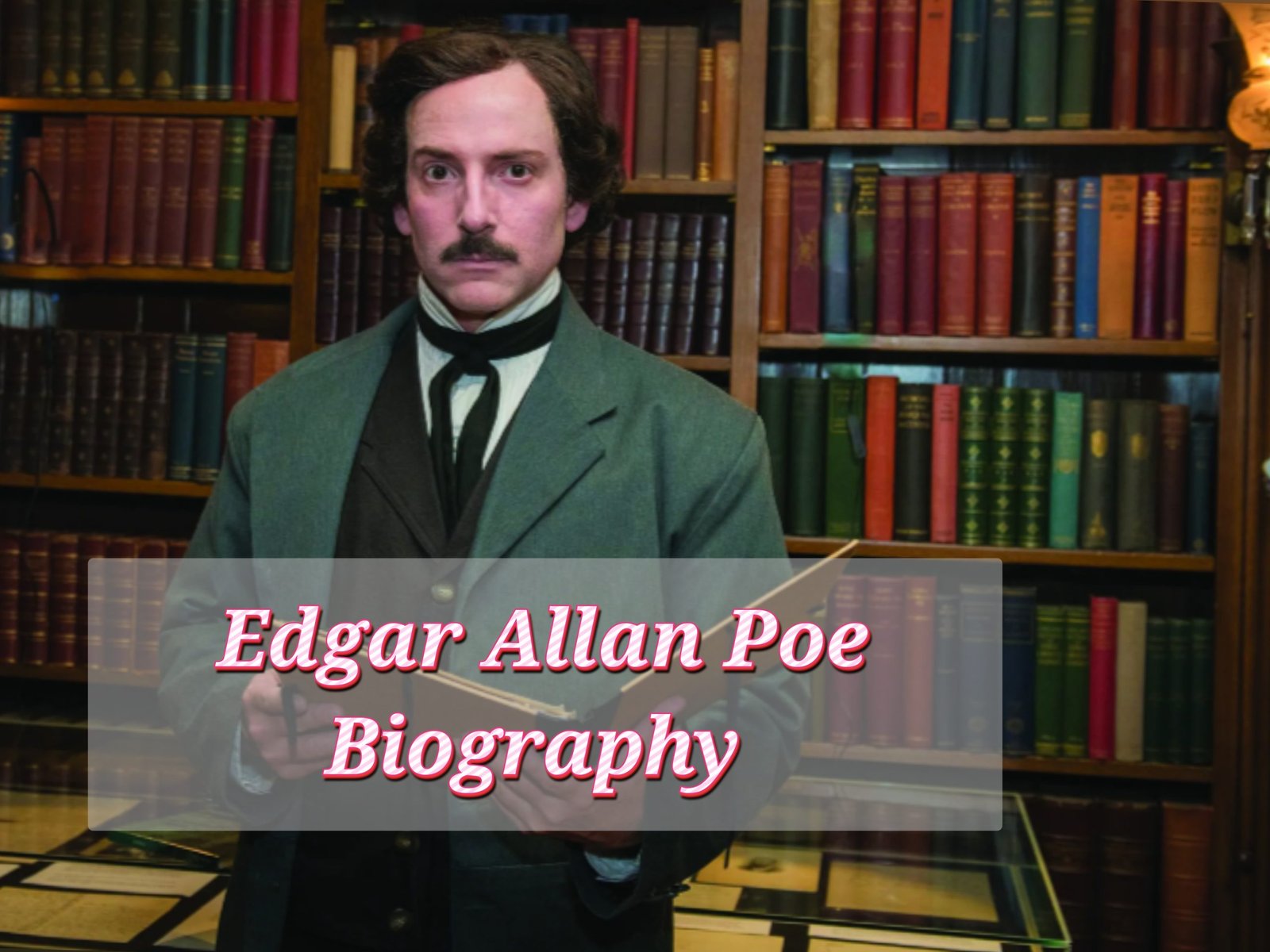
Edgar Allan Poe Biography
Edgar Allan Poe was an American writer, poet, editor, and literary critic born on January 19, 1809, in Boston, Massachusetts. He is widely regarded as a master of mystery, the macabre, and Gothic fiction. His innovative works helped shape short stories, detective fiction, and elements of science fiction. Poe lived a life marked by talent, tragedy, and financial hardship, dying at age 40 under mysterious circumstances. His influence extends far beyond his time, inspiring countless authors, artists, and creators worldwide.
Poe’s stories and poems explore themes of loss, madness, and the unknown with psychological depth and rhythmic language. Though he struggled during his lifetime, his legacy as a pioneer of American literature endures through classics like “The Raven” and tales that continue to captivate readers.
Edgar Allan Poe Early Life
Edgar Allan Poe, originally named Edgar Poe, entered the world on January 19, 1809, in Boston, Massachusetts, to traveling actors David Poe Jr. and Eliza Arnold Poe. His father, from a Baltimore family, abandoned the household around 1810, leaving his mother to support the children alone. Eliza, an English-born actress, died of tuberculosis on December 8, 1811, in Richmond, Virginia, when Edgar was just two years old.
This early loss left Edgar and his siblings orphaned. His older brother, William Henry Leonard Poe, went to live with relatives in Baltimore. His younger sister, Rosalie, was raised by another family in Richmond. Edgar found a home with John Allan, a prosperous Scottish merchant in Richmond, and his wife Frances. Though the Allans never formally adopted him, they gave him the middle name Allan, by which he became known as Edgar Allan Poe.
Life with the Allans provided some stability and privilege. In 1815, the family traveled to Britain, where Edgar attended schools in Scotland and England, receiving a solid classical education. They returned to Richmond in 1820. John Allan, a strict but sometimes indulgent guardian, hoped Edgar would join his business. Tensions arose as Edgar showed interest in writing rather than commerce. As a teenager, he participated in Richmond society, including serving in a youth honor guard for the Marquis de Lafayette in 1824.
Edgar Allan Poe Education
Poe’s formal education began during the family’s time in England. He studied at a boarding school in Stoke Newington and other institutions, gaining exposure to literature and languages. Back in Richmond, he attended local academies where he excelled academically and developed a reputation as a strong swimmer and athlete.
In 1826, at age 17, he enrolled at the University of Virginia in Charlottesville. There, he studied ancient and modern languages and performed well in classes. However, financial issues plagued him. John Allan provided limited support, and Poe accumulated gambling debts in an attempt to cover expenses. After less than a year, he left the university without completing his studies. This period also saw the end of his engagement to Sarah Elmira Royster, whose family had other plans for her.
Poe’s education continued informally through self-study and military training. His experiences at the University of Virginia and later at West Point shaped his disciplined approach to craft, even as conflicts with his foster father intensified.
Edgar Allan Poe Age
Poe lived a relatively short life, passing away at the age of 40. His productive years spanned from his late teens until his death in 1849. Despite his brief lifespan, he produced a substantial body of work that established him as a key figure in American Romanticism. Many of his most famous pieces emerged in his thirties, during periods of personal and financial strain.
Edgar Allan Poe Wife
In 1836, Poe married his 13-year-old first cousin, Virginia Eliza Clemm. Virginia, often called “Sissy,” came from Baltimore, where Poe had lived with her mother, Maria Clemm. The marriage was unconventional by modern standards, and accounts describe it as close and supportive, with Virginia and Maria providing emotional stability for Poe.
Virginia suffered from tuberculosis for several years and died in 1847 at age 24. Her illness and death deeply affected Poe, contributing to his struggles with grief and health. He referred to her affectionately in writings and relied on the household she helped maintain.
Edgar Allan Poe Career
Poe’s career began with poetry. In 1827, while in the army, he published “Tamerlane and Other Poems” under the pseudonym “A Bostonian.” Subsequent collections followed, including “Al Aaraaf, Tamerlane, and Minor Poems” (1829) and “Poems” (1831). He shifted toward prose for better financial prospects.
He worked as an editor and critic for publications like the “Southern Literary Messenger” in Richmond, “Burton’s Gentleman’s Magazine” and “Graham’s Magazine” in Philadelphia, and the “Broadway Journal” in New York. His sharp, often harsh reviews earned him respect and enemies. Poe advocated for high literary standards and American originality.
His short stories gained prominence in the 1830s and 1840s. Key works include “The Fall of the House of Usher,” “The Tell-Tale Heart,” “The Cask of Amontillado,” “The Pit and the Pendulum,” and “The Masque of the Red Death.” “The Murders in the Rue Morgue” (1841) introduced C. Auguste Dupin and is considered the first modern detective story. Poe also explored science fiction elements in tales like “The Unparalleled Adventure of One Hans Pfaall.”
In 1845, “The Raven” brought him widespread fame, though financial rewards were modest. He lectured, wrote essays like “The Philosophy of Composition,” and planned his own magazine, “The Stylus”, which never launched. Poe was one of the first Americans to try earning a full living from writing, facing poverty and instability as a result.
Edgar Allan Poe Achievements
Poe pioneered several genres. His detective tales influenced Arthur Conan Doyle’s Sherlock Holmes and the broader mystery field. The Mystery Writers of America named their awards “The Edgars” in his honor. His horror stories emphasized psychological terror and the uncanny, impacting writers like H.P. Lovecraft and Stephen King. He contributed to early science fiction and cosmology ideas.
His poetry, noted for musicality and rhythm, includes “The Bells” and “Annabel Lee.” As a critic, he shaped literary tastes. Museums in several cities preserve his legacy, and his works appear in popular culture across media.
Edgar Allan Poe Children
Poe and Virginia had no children. Virginia’s young age at marriage and her health issues likely contributed to this. Poe’s family line did not continue directly through descendants.
Edgar Allan Poe Siblings
Poe had two siblings. His brother, William Henry Leonard Poe, was a poet and sailor who died young in 1831. His sister, Rosalie Poe, lived into adulthood but had limited contact with Edgar and faced her own challenges. The siblings were separated after their mother’s death.
Edgar Allan Poe Family
The Poe family originated with actors on both sides. Grandfather David Poe Sr. supported the American Revolution. Foster father John Allan provided Poe’s primary upbringing but never adopted him legally, leading to ongoing conflicts, especially over inheritance after Allan’s death in 1834. Maria Clemm, Poe’s aunt and mother-in-law, was a constant support. The extended family included various relatives in Baltimore and Richmond.
Edgar Allan Poe Personal Life
Poe’s personal life was turbulent. He faced repeated financial difficulties, periods of drinking, and health issues. Relationships with women, including engagements after Virginia’s death, reflected his search for stability. He lived in various cities, moving for work opportunities. Grief over losses, particularly his mother’s and wife’s deaths from tuberculosis, infused his writing with themes of mourning and impermanence.
Edgar Allan Poe Awards
During his lifetime, Poe received limited formal awards. One early recognition was a prize for his story “MS. Found in a Bottle” in 1833. Posthumously, his influence earned lasting honors, such as the Edgar Awards for mystery writing.
Edgar Allan Poe Death
Poe died on October 7, 1849, in Baltimore, Maryland, at age 40. He was found delirious near a polling place on October 3, wearing unfamiliar clothes, and taken to Washington College Hospital. He slipped in and out of consciousness, unable to explain events. The official cause was listed as “phrenitis” or congestion of the brain, but theories include alcoholism, rabies, heart issues, or election-related foul play. His death remains a mystery, fitting for his literary style. He was buried in Westminster Hall and Burying Ground in Baltimore.
Edgar Allan Poe Net Worth
Poe died in relative poverty. His earnings from writing were modest, and he often struggled with debts. At death, his estate held little value, reflecting the challenges of a literary career in 19th-century America.
Edgar Allan Poe Legacy
Poe’s legacy as a transformative figure in literature is profound. He elevated the short story form and brought psychological insight to horror and mystery. His works continue to be studied, adapted into films, music, and more. Homes associated with him are museums, and his influence spans global literature and popular culture. Despite personal hardships, his creative output secured his place among America’s greatest writers.
Conclusion
Edgar Allan Poe’s life was one of brilliance shadowed by adversity. From orphaned child to literary innovator, he crafted enduring works that probe the human psyche and the unknown. His contributions to poetry, fiction, and criticism continue to resonate, ensuring his voice echoes through generations.
FAQs
What is Edgar Allan Poe best known for?
Edgar Allan Poe is best known for poems like “The Raven” and short stories featuring mystery, horror, and psychological depth, such as “The Tell-Tale Heart” and “The Fall of the House of Usher.”
When and where was Edgar Allan Poe born?
He was born on January 19, 1809, in Boston, Massachusetts.
Did Edgar Allan Poe have any children?
No, Edgar Allan Poe and his wife Virginia had no children.
How did Edgar Allan Poe die?
He died on October 7, 1849, in Baltimore under mysterious circumstances. The exact cause remains unknown, with various medical and circumstantial theories proposed.
What genres did Edgar Allan Poe pioneer?
He pioneered modern detective fiction, contributed significantly to Gothic horror, and influenced early science fiction.
Who raised Edgar Allan Poe?
John and Frances Allan of Richmond, Virginia, raised him as a foster child after his mother’s death.