
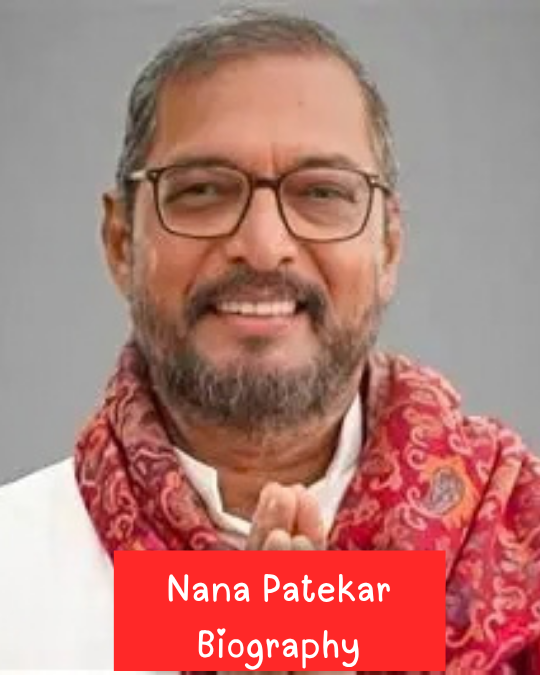
Nana Patekar was an Indian actor, filmmaker and writer whose career transformed him into one of the most distinctive performers in Hindi and Marathi cinema. Known for his powerful voice, intense expressions and ability to move between serious drama and comedy, he built a career that lasted nearly five decades.
Born Vishwanath Patekar, he became widely recognized through films such as Parinda, Krantiveer, Agni Sakshi, Ab Tak Chhappan, Raajneeti, Welcome and Natsamrat. He won three National Film Awards and received the Padma Shri for his contribution to Indian cinema and arts. Patekar died on October 8, 2026, at the age of 75 after suffering cardiac arrest at his home in Goa.
Nana Patekar Age and Real Name
Nana Patekar was born Vishwanath Patekar on January 1, 1951, in Murud-Janjira, Maharashtra, India. He came from a Marathi family and later became known professionally by the name Nana. He was 75 years old when he died in October 2026.
His early years were shaped by financial difficulty. Before becoming a successful actor, he experienced hardship and worked at different jobs while pursuing his education and artistic interests. Those experiences later became part of the public understanding of his direct and unsentimental approach to acting.
Patekar studied at the Sir J.J. Institute of Applied Art in Mumbai. His artistic training and early interest in theatre helped him develop the expressive style that eventually became one of his trademarks.
How Nana Patekar Started Acting
Patekar began his professional acting career through Marathi theatre before moving into films. Theatre gave him an environment in which voice, physical expression and dialogue carried enormous importance, qualities that later became central to his screen performances.
His Hindi film debut came with Gaman in 1978. The film marked the beginning of a screen career that initially developed through serious and unconventional roles rather than the traditional romantic-hero image associated with mainstream Bollywood.
He continued working in both Hindi and Marathi productions as his reputation grew. His performances attracted attention because he could portray difficult, morally complicated and emotionally volatile characters without relying heavily on conventional star mannerisms.
Nana Patekar Movies and Breakthrough
One of the most important breakthroughs in Patekar’s career came with Parinda in 1989. His performance earned him the National Film Award for Best Supporting Actor and a Filmfare Award in the same category.
He followed that success with major roles in films including Raju Ban Gaya Gentleman, Angaar, Tirangaa and Krantiveer. In Krantiveer, he played Pratap Narayan Tilak, a troubled man who becomes a forceful voice against social and political corruption. The performance earned him the National Film Award for Best Actor.
His filmography from the 1990s showed the range that would define his reputation. He appeared in serious dramas, thrillers and commercial productions while continuing to work in projects that dealt with social issues and difficult characters.
Krantiveer and National Film Awards
Krantiveer became one of the defining films of Patekar’s career. His performance combined anger, vulnerability and social commentary, allowing him to carry a character whose personal transformation drives much of the story.
Patekar eventually won three National Film Awards during his career. His other National Award-winning performances included Parinda and Agni Sakshi, making him one of the rare Indian performers to receive the country’s highest film honor multiple times.
His achievements were not limited to one type of cinema. He earned recognition in both mainstream productions and films associated with India’s parallel or realistic cinema movement.
Salaam Bombay and International Recognition
Patekar gained wider international attention through Mira Nair’s Salaam Bombay!, the 1988 film that received an Academy Award nomination for Best Foreign Language Film. The movie focused on children living on the streets of Mumbai and presented a stark portrait of poverty and survival.
His involvement in serious, socially conscious cinema helped distinguish him from actors whose careers were built primarily around commercial entertainment. His performances often gave difficult subjects a human dimension without simplifying the characters.
That combination of commercial success and serious acting became one of the most important features of his career.
Nana Patekar in Welcome
Although Patekar was already an established dramatic actor, a new generation of viewers discovered his comic timing through Welcome in 2007. He played Uday Shetty, a gangster whose attempts to arrange his sister’s marriage create the central comic situation.
The role allowed Patekar to use his naturally forceful delivery for comedy. His scenes with Anil Kapoor became among the film’s most remembered sequences, and he later returned as Uday in Welcome Back in 2015.
His success in comedy demonstrated that the intensity associated with his dramatic performances could also become a source of humor. It further expanded his appeal among mainstream Bollywood audiences.
Natsamrat and Marathi Cinema
Patekar returned to the center of Marathi cinema with Natsamrat in 2016. He played Ganpat Belwalkar, a retired stage actor whose later life is marked by family conflict, loneliness and memories of his theatrical career.
The performance received widespread critical recognition and earned him the Filmfare Award for Best Actor in Marathi. The film also reflected his longstanding connection with theatre and Marathi artistic culture.
Natsamrat became an important late-career role because it brought together several elements of his professional identity: theatre, Marathi culture, emotional drama and a character built around performance itself.
Later Movies and Career
Patekar continued acting into his seventies. His later film credits included Gadar 2, The Vaccine War, Vanvaas, Housefull 5, O’ Romeo and Subedaar. His filmography therefore remained active even after decades at the top of Indian cinema.
He also worked as a director and writer. His directorial debut was Prahaar: The Final Attack, released in 1991. His work behind the camera added another dimension to a career that had already crossed acting, theatre and screenwriting.
His ability to remain relevant across different periods of Bollywood was partly due to his willingness to take supporting roles, character parts and comic performances rather than limiting himself to a conventional leading-man identity.
Nana Patekar Wife and Son
Nana Patekar was married to Neelakanti Patekar, and they had one son, Malhar Patekar. The couple lived separately in later years, although they remained connected through their family.
Malhar later worked in the film industry, including as a director, continuing the family’s connection with cinema. Patekar generally maintained a relatively private approach to his personal life despite his decades of public visibility.
His family received renewed attention following his death, with reports confirming that he was survived by his wife and son.
Nana Patekar Philanthropy and Social Work
Patekar was also known for supporting people affected by poverty and rural hardship. In 2015, he helped establish the Naam Foundation with fellow Marathi actor Makarand Anaspure. The organization has focused on assisting farmers and rural communities affected by drought and financial difficulties.
His charitable activities added another dimension to his public life. Rather than limiting his involvement in social issues to film roles, he participated in efforts aimed at providing practical assistance to communities in Maharashtra.
His connection with rural Maharashtra remained significant even after he became one of India’s most recognizable actors.
Nana Patekar Controversy
Patekar’s career also included controversy. In 2018, actress Tanushree Dutta accused him of sexual harassment in connection with an incident on the set of the 2008 film Horn ‘Ok Pleassss. Patekar denied the allegation. The accusation became part of the wider #MeToo discussion in India’s entertainment industry.
The matter should be distinguished from the many documented achievements of his acting career. It became an important part of public discussion around Patekar, but the allegation was denied and should not be presented as an established finding of wrongdoing.
Nana Patekar Awards
Patekar’s major honors included three National Film Awards, four Filmfare Awards and other regional and industry recognitions. He also received the Padma Shri in 2013 for his contribution to films and the arts.
His National Film Awards covered both Best Actor and Best Supporting Actor categories. His ability to receive recognition for dramatically different types of roles reflected the breadth of his acting career.
His awards ultimately confirmed what audiences had recognized for years: Patekar could command attention without relying on conventional star presentation.
Nana Patekar Death
Nana Patekar died on October 8, 2026, at his home in Goa. He was 75. He was reportedly found unconscious and taken to Manipal Hospital, where doctors were unable to revive him. Hospital authorities identified cardiac arrest as the cause of death, although the specific trigger was not immediately known.
His death ended a career that had lasted almost five decades. Tributes came from across Indian cinema, including actor Akshay Kumar, who praised Patekar’s distinctive talent and screen presence.
For audiences in India and beyond, his death marked the passing of an actor whose voice, dialogue delivery and ability to inhabit difficult characters had become instantly recognizable.
Nana Patekar’s Legacy
Patekar’s importance to Indian cinema rests on the range of roles he could perform without losing his distinctive identity. He could play an angry social outsider in Krantiveer, a complex police officer in Ab Tak Chhappan, a politician in Raajneeti, a gangster in Welcome and an aging theatre actor in Natsamrat.
His career also crossed the boundaries between Marathi and Hindi cinema. He maintained a connection with theatre and regional filmmaking while becoming a major mainstream Bollywood performer.
Nana Patekar died at 75 after nearly five decades in the industry. His most enduring work remains tied to performances that demonstrated how a powerful voice, disciplined acting and emotional intensity could create memorable characters without conventional movie-star formulas.
Frequently Asked Questions
What was Nana Patekar’s real name?
Nana Patekar was born Vishwanath Patekar in Maharashtra in 1951.
How old was Nana Patekar when he died?
He was 75 years old when he died on October 8, 2026.
What was Nana Patekar famous for?
He was known for films including Parinda, Krantiveer, Agni Sakshi, Ab Tak Chhappan, Welcome and Natsamrat.
How many National Film Awards did Nana Patekar win?
He won three National Film Awards during his acting career.
Who was Nana Patekar’s wife?
He was married to Neelakanti Patekar, and they had one son, Malhar.
What caused Nana Patekar’s death?
He died after cardiac arrest at his home in Goa, according to doctors at Manipal Hospital.
Conclusion
Nana Patekar built one of Indian cinema’s most distinctive careers by moving comfortably between theatre, Marathi films, serious Hindi cinema and mainstream Bollywood entertainment. His performances in Parinda, Krantiveer, Welcome and Natsamrat demonstrated a range that few actors of his generation matched.
His death in 2026 closes a remarkable chapter in Hindi and Marathi cinema. Yet the characters he created, from socially troubled protagonists to comic gangsters and aging theatre performers, ensure that his work will remain part of India’s cinematic history.