
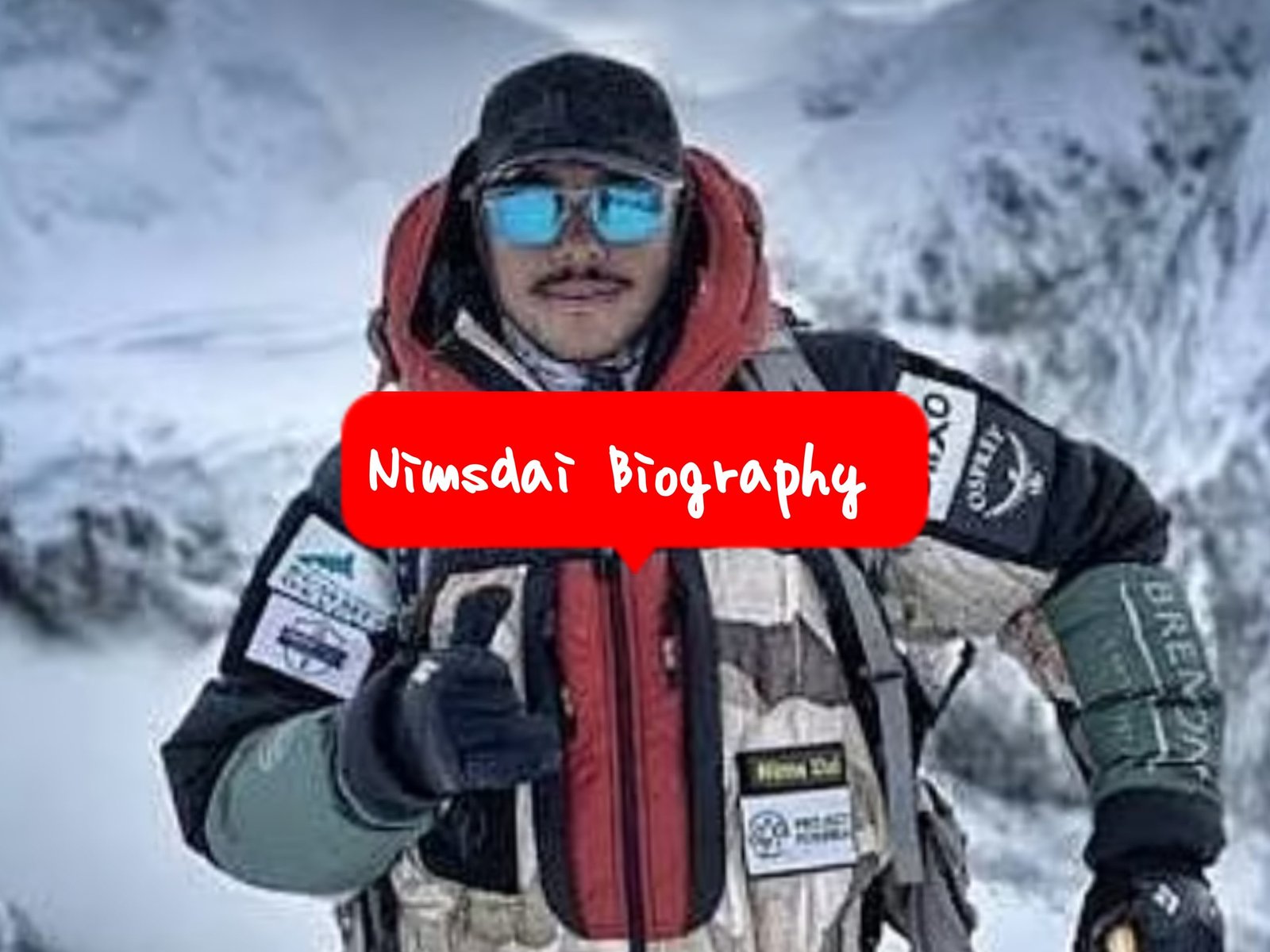
Nimsdai Biography
Nirmal Purja, popularly known as Nimsdai or Nims, was born in Dana, Myagdi District, Nepal, and held both Nepali heritage and British nationality. He became one of the most celebrated mountaineers in modern history, a former Gurkha soldier, and a decorated member of the United Kingdom’s Special Boat Service. His life journey took him from a small mountain village to the summit of the world’s highest peaks, and his name became inseparable from the phrase that defined his career: nothing is impossible.
This biography looks at the full story of Nimsdai, from his humble beginnings in Nepal to his record breaking climbing career, his time in the British military, his personal life, and the achievements that made him a global icon. It also covers the tragic events of 2026, when his life came to an end during an expedition in Pakistan. His story continues to inspire people across the world who believe that determination and self belief can carry a person beyond what seems achievable.
Nimsdai’s Full Name and Background
Nimsdai’s full name is Nirmal Purja. He was born on 25 July 1983 in the village of Dana, located in the Myagdi District near Nepal’s Dhaulagiri mountain range. He held British nationality, having settled in the United Kingdom during his military career, while also carrying deep pride in his Nepali roots. His family belonged to the Magar ethnic community, one of the indigenous groups of the Nepali hills known for their long history of service in the Gurkha regiments.
Early Life of Nimsdai
Nimsdai was born on 25 July 1983 into a family of modest means. His father served as a Gurkha soldier, and his mother came from a farming background. Their marriage crossed traditional caste boundaries, a decision that distanced them from parts of their extended family. This act of defiance against convention left an early impression on young Nirmal, who later spoke about how his parents’ resilience shaped his own determination to break barriers.
Although he was born in Dana, Nimsdai spent much of his childhood in Chitwan, a district in the lowland plains of Nepal, far removed from the high mountains that would later define his life. Growing up, his family did not have significant wealth, and life required discipline and hard work from an early age. He was the youngest of four children, and his older brothers had already followed the family tradition of joining the British Gurkhas, a path that had offered generations of Nepali men a route out of poverty and into a respected career.
As a boy, Nimsdai’s ambition was not to become a mountaineer. Climbing was not part of his early dreams. Instead, he wanted to follow in the footsteps of his father and brothers by joining the Brigade of Gurkhas, a career that carried prestige within his community and offered a chance at financial stability for his family. This early goal set the foundation for the disciplined and determined character that would later carry him to the top of the world’s highest mountains.
Nimsdai’s State of Origin and Roots
Nimsdai was from Dana, a small village situated in the Myagdi District of Gandaki Province in Nepal, close to the Dhaulagiri Himalayan range. Myagdi is a mountainous district in western Nepal known for its dramatic landscapes, terraced farms, and strong tradition of supplying recruits to the Gurkha regiments of both the British and Indian armies. The district sits in the shadow of Dhaulagiri, the seventh highest mountain in the world, meaning that Nimsdai grew up with towering peaks as a backdrop even before he considered climbing them.
The Magar community, to which Nimsdai belonged, is one of the largest indigenous groups in Nepal. Magars have a long and proud history of military service, and many of Nepal’s most respected soldiers have come from this community. Growing up within this cultural setting exposed Nimsdai to values of courage, endurance, and loyalty from a young age, qualities that would later become the hallmark of his climbing career. Even after achieving global fame, Nimsdai frequently spoke about his origins with pride, crediting his upbringing in Nepal for the mental toughness that carried him through some of the most dangerous expeditions in mountaineering history.
Nimsdai’s Career
Joining the Brigade of Gurkhas
Nimsdai joined the Brigade of Gurkhas in 2003, following a path well known to many young men from his region. Selection into the Gurkhas is famously demanding, requiring extreme physical fitness, mental toughness, and the ability to endure gruelling training exercises. Nimsdai passed this rigorous process and began his military journey, serving six years in the regiment before setting his sights on an even more elite unit.
Becoming the First Gurkha in the Special Boat Service
In 2009, Nimsdai achieved a milestone that had never been accomplished before. He successfully passed selection for the United Kingdom’s Special Boat Service, the elite special forces unit of the Royal Navy, becoming the first Gurkha soldier in history to join the unit. This achievement alone marked him as an exceptional soldier, given the extremely low success rate of SBS selection. Over the following decade, he served as a cold weather warfare specialist, taking part in operational deployments including tours in Afghanistan. His military background instilled in him the discipline, composure under pressure, and logistical thinking that later defined his approach to high altitude mountaineering.
Discovering Mountaineering
Nimsdai’s introduction to serious mountaineering happened somewhat by accident. In December 2012, while on leave from the military, he set out on what was meant to be a straightforward trek to Everest Base Camp. During the trip, he persuaded his guide to let him attempt a nearby peak called Lobuche East instead. He summited it successfully, marking his first climb above 6,000 metres. The experience ignited a passion that would eventually reshape his entire life.
He returned to the Everest region during further periods of military leave and continued building his climbing experience. By 2016, he had already carried out a high altitude rescue mission that saved a Gurkha expedition from failure, an act of bravery that later contributed to his recognition by the British honours system.
Project Possible and the 14 Peaks Record
The defining moment of Nimsdai’s career came in 2019 with the launch of Project Possible, an audacious plan to climb all fourteen of the world’s mountains above 8,000 metres, known as the eight thousanders, within seven months. At the time, the existing record for completing all fourteen peaks stood at nearly eight years, set by Polish climber Jerzy Kukuczka in the 1980s. Many in the climbing world doubted that Nimsdai’s target was achievable.
He began the expedition in April 2019 with Annapurna, followed quickly by Dhaulagiri, Kanchenjunga, Everest, Lhotse, and Makalu, completing the first phase of six peaks within a single month. He then moved to Pakistan for the second phase of his mission, tackling the notoriously dangerous Nanga Parbat before summiting Broad Peak and other Karakoram giants. He completed the full sequence of all fourteen peaks in just six months and six days, smashing the previous record and stunning the global mountaineering community. This achievement became one of the most celebrated feats in the history of the sport and transformed Nimsdai from a relatively unknown former soldier into an international icon.
The First Winter Ascent of K2
Having conquered the 8000ers in record time, Nimsdai set his sights on one of mountaineering’s last great unsolved challenges: a winter ascent of K2, the world’s second highest mountain, known for its extreme difficulty and unpredictable weather. Every eight thousander had by then been climbed in winter except K2, and many considered it close to impossible.
In January 2021, Nimsdai led a team of ten Nepali climbers to the summit of K2 in brutal winter conditions, achieving the first successful winter ascent in the mountain’s history. Remarkably, he was the only member of the team to reach the top without the aid of supplementary oxygen, becoming the first person ever to do so on K2 in winter. The achievement was hailed across the world as one of the greatest feats in modern mountaineering and cemented his reputation as one of the finest high altitude climbers of his generation.
Later Climbing Achievements
Nimsdai continued to push boundaries in the years that followed. In May 2022, he completed the first ever traverse from the summit of Everest to Lhotse via the South Col not once but twice within the same climbing season, first on 16 May and again on 28 May. That same year, he also achieved the first triple header of three eight thousanders without supplementary oxygen, summiting Kanchenjunga, Everest, and Lhotse within eight days, twenty three hours, and eleven minutes. He also held records for the fastest ascent of Everest, Lhotse, and Makalu combined, completing the three summits in just 48 hours.
Beyond his personal climbs, Nimsdai built Elite Exped, his own high altitude expedition company, guiding other climbers on some of the world’s most demanding mountains. He became known within the industry for his emphasis on safety, teamwork, and giving credit to the Nepali and Sherpa climbers who worked alongside him, often highlighting how much of his success depended on the strength of his team.
Author and Documentary Subject
Nimsdai’s remarkable story reached an even wider audience through two major projects. In November 2020, he published his memoir, Beyond Possible, later released in some markets under the title Beyond Possible: One Soldier, Fourteen Peaks. The book detailed his journey from a Gurkha soldier to record breaking mountaineer and became a bestseller, praised by reviewers for its honest and inspiring account of leadership and human endurance.
In 2021, Netflix released 14 Peaks: Nothing Is Impossible, a documentary directed by Torquil Jones that chronicled his Project Possible expedition. The film introduced Nimsdai to millions of viewers around the world who had never previously followed mountaineering, turning him into a household name far beyond the climbing community.
Advocacy and Environmental Work
Nimsdai used his platform to speak on issues affecting the Himalayas. During his 2019 Everest climb, he captured a widely shared photograph showing a long line of climbers waiting near the summit. The image became one of the most discussed photographs ever taken on the mountain, drawing global attention to overcrowding, safety risks, and the environmental pressures facing Everest during peak climbing season.
He served as a Mountain Advocate for the United Nations Environment Programme, using his voice to campaign for the protection of high altitude environments and the communities that depend on them. He was also recognised as a Global Goodwill Ambassador for Nepal Tourism, promoting his home country as a destination for adventure travel and highlighting the contribution of Nepali climbers to the mountaineering industry.
Nimsdai’s Achievements and Records
Nimsdai’s list of records grew steadily throughout his climbing career and included the completion of all fourteen eight thousand metre peaks in six months and six days, a mark that stood as the record until it was surpassed in 2023. He achieved the fastest combined ascent of Everest, Lhotse, and Makalu in 48 hours. He led the first successful winter ascent of K2 and became the first person to summit that mountain in winter without supplementary oxygen. He completed the first double traverse of Everest to Lhotse within a single season and set the record for the fastest triple header of three eight thousanders without bottled oxygen. Guinness World Records recognised him with multiple entries related to his high altitude achievements.
Nimsdai’s Awards
Nimsdai received the MBE, Member of the Order of the British Empire, awarded for outstanding achievement in extreme high altitude mountaineering. The honour recognised both his daring 2016 rescue of a stranded Gurkha expedition and his remarkable climbing accomplishments on the 8000ers. In 2022, Loughborough University presented him with a Distinguished Alumni Award in recognition of his record breaking career and his advocacy work with the United Nations Environment Programme and Nepal’s mountaineering community. He also received widespread recognition from mountaineering organisations and adventure sport bodies around the world, and his Project Possible achievement was described by legendary climber Reinhold Messner, the first person to summit all fourteen eight thousanders, as truly astonishing in its magnitude.
Nimsdai’s Personal Life
Nimsdai married Suchi Purja in 2006, shortly after he joined the British Army’s Gurkha regiment. Suchi, the daughter of a Gurkha soldier named Tej Gurung, understood the demands of military life from her own upbringing. The couple settled in Hampshire, England, building a home life that stood in quiet contrast to the extreme conditions Nimsdai regularly faced on expeditions. Suchi trained as a dental hygienist and therapist in the United Kingdom and also took on directorial roles connected to her husband’s business and charitable ventures, while largely staying out of the public spotlight despite his global fame.
In 2022, the couple welcomed their first child, a daughter named Himani. Nimsdai often spoke publicly about his gratitude toward his wife and daughter, crediting their support for making his ambitious expeditions possible. Despite the intensity of his career, he made efforts to keep his family life private, sharing only occasional glimpses of his home life on social media.
Nimsdai also founded the Nimsdai Foundation in 2022, a charitable organisation focused on supporting mountain communities, education, and humanitarian projects connected to Nepal. Through the foundation and his expedition company Elite Exped, he remained deeply connected to the country of his birth even as his career carried him around the world.
Nimsdai’s Death
On 30 July 2026, Nimsdai was leading a group of ten climbers on Broad Peak, an 8,051 metre mountain in Pakistan’s Karakoram range, when a massive avalanche struck the expedition’s route around midday local time. The mountain, known for its technically difficult climbing conditions, had experienced heavy snowfall in the days leading up to the disaster, and most other expedition teams had already left the area by the time Nimsdai’s group remained.
All ten members of the expedition, including climbers from Nepal, Pakistan, Oman, the United States, and China, were reported missing following the avalanche. Rescue teams faced extremely difficult terrain and challenging weather conditions during the search operation. On 1 August 2026, Nimsdai’s company, Elite Exped, confirmed in a statement that he had tragically lost his life following the avalanche, along with other members of the expedition. His body, along with those of several fellow climbers, was later recovered from the mountain, though the search for the remaining missing climbers continued for several more days.
Tributes poured in from around the world following the news. Nepal’s Prime Minister, Balendra Shah, expressed shock at the loss and praised the courage and contributions of the climbers who died. The Nimsdai Foundation shared a message stating that his legacy would live on in the countless lives he changed and the people he inspired to climb their own mountains, whatever form those mountains might take. He was 43 years old at the time of his death.
Nimsdai’s Legacy
Nimsdai’s death brought an unexpected end to one of the most extraordinary careers in the history of mountaineering, but his impact on the sport and on popular understanding of human potential remains significant. He proved that records long considered untouchable could be broken through preparation, teamwork, and unwavering self belief. He also played an important role in shifting global recognition toward the Nepali and Sherpa climbers who have long formed the backbone of Himalayan expeditions but historically received less credit than their foreign clients.
His memoir and documentary continue to inspire readers and viewers who may never set foot on a mountain, offering lessons in discipline, leadership, and resilience that extend far beyond climbing. Elite Exped and the Nimsdai Foundation continue to carry forward parts of his mission, supporting mountain communities and the next generation of climbers who grew up watching his achievements.
Conclusion
Nimsdai’s journey from a small village in Nepal’s Myagdi District to the summits of the world’s highest and most dangerous mountains stands as one of the most remarkable stories in modern sporting history. He moved from a career as a Gurkha soldier and Special Boat Service operator into a mountaineering legacy that redefined what was thought possible in high altitude climbing. His record breaking Project Possible expedition, his historic winter ascent of K2, and his tireless advocacy for Nepal’s mountaineering community left a mark that will not be forgotten. Though his life was cut short in the avalanche on Broad Peak in 2026, the discipline, humility, and determination he brought to every climb continue to inspire people across the world to pursue their own version of the impossible.
FAQs
Who was Nimsdai?
Nimsdai, whose full name was Nirmal Purja, was a Nepal born mountaineer and former British Gurkha and Special Boat Service soldier who became famous for climbing all fourteen of the world’s 8,000 metre peaks in a record six months and six days.
Where was Nimsdai born?
Nimsdai was born on 25 July 1983 in Dana, a village in the Myagdi District of Gandaki Province, Nepal, near the Dhaulagiri mountain range.
What was Nimsdai’s biggest achievement?
His biggest achievement was Project Possible, an expedition in which he climbed all fourteen of the world’s eight thousand metre peaks in just six months and six days, shattering the previous record of nearly eight years.
Did Nimsdai climb K2 in winter?
Yes. In January 2021, Nimsdai led a team of ten Nepali climbers to complete the first successful winter ascent of K2, and he was the only member of the team to summit without supplementary oxygen.
Was Nimsdai married?
Yes. Nimsdai married Suchi Purja in 2006, and the couple had a daughter named Himani, born in 2022. They lived together in Hampshire, England.
How did Nimsdai die?
Nimsdai died on 30 July 2026 after an avalanche struck his expedition on Broad Peak, an 8,051 metre mountain in Pakistan’s Karakoram range. His death was confirmed by his expedition company, Elite Exped, on 1 August 2026.
Did Nimsdai write a book?
Yes. Nimsdai wrote a memoir titled Beyond Possible, published in November 2020, which chronicled his journey from Gurkha soldier to record breaking mountaineer.
Was there a documentary about Nimsdai?
Yes. Netflix released a documentary titled 14 Peaks: Nothing Is Impossible in 2021, which followed his Project Possible expedition and introduced his story to a global audience.
What awards did Nimsdai receive?
Nimsdai was awarded the MBE for his high altitude rescue work and mountaineering achievements. He also received a Distinguished Alumni Award from Loughborough University and multiple Guinness World Records recognitions.