
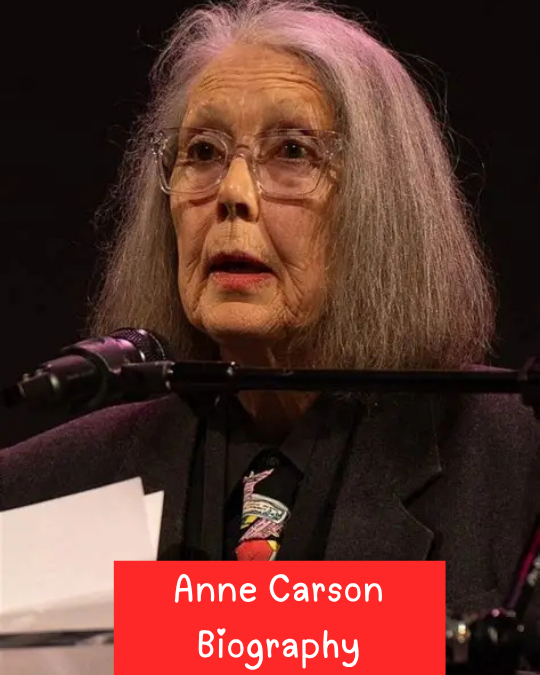
Anne Carson is a Canadian poet, essayist, classicist and translator known for bringing ancient Greek literature into conversation with modern life. Her writing combines poetry, prose, scholarship, translation and visual experimentation, often challenging the boundaries between literary genres. She became an international literary figure through works such as Eros the Bittersweet, Autobiography of Red and Nox.
On October 8, 2026, Carson won the Nobel Prize in Literature for her inventive body of work and its engagement with classical traditions. The award brought new attention to a writer whose career has developed through academic research, experimental literature and a distinctive approach to language.
Anne Carson Age and Early Life
Anne Carson was born on June 21, 1950, in Toronto, Ontario, Canada. She is 76 years old in 2026. Her interest in classical literature began during her school years, when a Latin teacher introduced her to ancient Greek language and literature. That experience helped shape the academic and creative direction she would follow throughout her career.
Carson’s fascination with ancient texts developed into a lifelong interest in how words carry meaning across different periods and cultures. Rather than treating classical literature as something distant from modern experience, she explored ways to make its themes relevant to contemporary readers.
This interest became central to her writing. Love, desire, loss, identity and the limits of language appear throughout her work, often through unusual structures that combine scholarly inquiry with creative expression.
Anne Carson Education and Academic Career
Carson studied at the University of Toronto’s St. Michael’s College. Although she left university twice, she returned and completed her bachelor’s degree in 1974, master’s degree in 1975 and doctorate in 1981. She also studied Greek metrics at the University of St Andrews in Scotland. Her doctoral research focused on ancient Greek literature and later contributed to her first major critical book.
Her academic career included teaching and research positions at universities in Canada and the United States. She taught at Princeton University and later held roles at institutions including McGill University, the University of Michigan and the University of California, Berkeley.
Carson’s scholarship was never entirely separate from her creative writing. Her knowledge of ancient Greek language, poetry and philosophy gave her material to reinterpret, while her poetic imagination allowed her to approach academic subjects in unconventional ways.
How Anne Carson Became a Writer
Carson’s writing began attracting wider attention through her poetry and literary criticism. Her book Eros the Bittersweet, published in 1986, explored desire through ancient Greek literature and philosophy. The work established her as a distinctive voice capable of combining close academic analysis with a compelling literary style.
Her long poem Kinds of Water helped bring her poetry to a wider literary audience in the late 1980s. She continued developing a style that moved freely between verse, essays, narrative and translation, rather than following a single conventional form.
Carson’s work often asks readers to reconsider familiar literary categories. A book may resemble a novel while behaving like a poem, or use scholarly commentary as part of a creative narrative. This willingness to experiment became one of the defining features of her career.
Anne Carson Books and Notable Works
Carson’s bibliography includes poetry collections, literary criticism, translations, essays and experimental books. Several works are particularly important for understanding her development and the reasons readers continue to discover her writing.
Eros the Bittersweet
Published in 1986, Eros the Bittersweet examines desire through ancient Greek poetry, especially the relationship between love, distance and longing. Carson considers how desire often depends on separation, uncertainty and the tension between wanting someone and being unable to possess them.
The book demonstrates how her classical scholarship can become a way of exploring experiences that remain familiar to modern readers. It also established themes that would reappear in her later poetry.
Autobiography of Red
Published in 1998, Autobiography of Red is one of Carson’s best-known works. It reimagines the Greek myth of Geryon, a red-winged monster associated with the story of Heracles, as a contemporary coming-of-age narrative written in verse.
The book combines mythology, adolescence, desire and emotional vulnerability. Its unusual form helped establish Carson as a writer who could transform classical material without simply retelling an ancient story. The work is often regarded as a defining example of her inventive approach to literature.
The Beauty of the Husband
In The Beauty of the Husband, published in 2001, Carson explores marriage, desire, betrayal and the difficulty of understanding another person. Subtitled “A Fictional Essay in 29 Tangos,” the book combines poetry with elements of essay and narrative.
It received the T. S. Eliot Prize for Poetry, adding to her growing international recognition. The work demonstrates her ability to examine intimate human relationships through a form that resists easy classification.
Nox
Published in 2010, Nox is an experimental memorial book created after the death of Carson’s brother. It combines poetry, translation, photographs, fragments and personal reflections, including material connected to Catullus’s poem about mourning a lost brother.
The book is notable for treating grief as an experience that cannot always be organized into a straightforward narrative. Its physical design and mixture of text and images make it different from a conventional poetry collection.
Other Important Books
Carson’s other notable works include Men in the Off Hours, Red Doc>, Float, Antigonick, If Not, Winter: Fragments of Sappho and Wrong Norma. Her translations include works by Sophocles and Euripides, as well as fragments of poetry by Sappho.
Her 2024 collection Wrong Norma received further recognition, including attention from major literary award organizations. Together, these books show the breadth of her interests and her continuing willingness to experiment with literary form.
Anne Carson Writing Style and Literary Influence
Carson’s writing is difficult to place within a single category because she moves between poetry, prose, translation, criticism and visual art. Her academic training gives her work a close attention to words and their origins, but she often uses that knowledge in ways that depart from traditional scholarly writing.
Classical Greek literature remains a major influence. Instead of reproducing ancient texts in a purely historical manner, she brings their conflicts and questions into contemporary settings. This allows stories about desire, grief, violence and identity to take on new meanings.
Her approach has influenced discussions about the possibilities of modern poetry and translation. Carson has shown that scholarly research and creative invention can work together, creating books that challenge readers while remaining deeply concerned with human experience.
Anne Carson Awards and Achievements
Carson’s awards reflect her influence across poetry, translation and literary scholarship. Before winning the Nobel Prize in Literature in 2026, she received a MacArthur Fellowship in 2000 and a Guggenheim Fellowship. She also won the T. S. Eliot Prize for The Beauty of the Husband and received the Griffin Poetry Prize, among other honors.
Her 2026 Nobel Prize represents the most prominent recognition of her career. The Swedish Academy praised her bold and inventive body of work, particularly the way she engages with classical traditions while creating new forms for contemporary literature.
The award also brought attention to a writer whose influence had developed through literary communities and academic circles rather than conventional celebrity. It introduced her work to a wider international audience.
Anne Carson Nobel Prize in Literature 2026
The Swedish Academy announced Carson as the 2026 Nobel Prize in Literature laureate on October 8. The citation recognized her innovative writing and her playful engagement with classical literature to create new forms for modern readers.
Carson was in Iceland when she received news of the award. Her reaction was one of surprise, and she joked that the prize would mean a sticker on the front of her books. She has lived in Iceland while maintaining connections to North American academic and literary life.
The Nobel Prize confirmed the international standing of a career built on experimentation rather than adherence to traditional literary categories. It also highlighted the continuing influence of classical literature in contemporary writing.
Anne Carson Personal Life
Carson keeps much of her personal life private. She has generally allowed her books, teaching and public literary appearances to define her profile rather than sharing extensive details about relationships or family.
Her work Nox offers an unusually personal view of grief following her brother’s death, but it should not be treated as a complete account of her private life. The book is an artistic response to loss, combining personal memory with translation and visual material.
Carson has also spoken about her life as a visual artist as well as a writer. Her books often reflect that interest through page design, images and unconventional arrangements of text.
Anne Carson Health and Recent Life
In recent years, Carson has discussed living with Parkinson’s disease. She has continued to engage with literature and creative work while adapting to the challenges associated with the condition. Reports surrounding her Nobel Prize also noted that she had taken up boxing lessons as part of managing its effects.
Her health has not defined her literary identity, which remains rooted in poetry, classical scholarship and experimentation. The 2026 Nobel recognition focused on her body of work and its contribution to contemporary literature.
Her continued creative activity reflects the long development of a career that has never depended on a single genre or conventional publishing formula.
Frequently Asked Questions
How old is Anne Carson?
Anne Carson is 76 years old in 2026. She was born on June 21, 1950, in Toronto, Canada.
What is Anne Carson famous for?
She is known for experimental poetry, essays, classical scholarship and translations. Her best-known books include Autobiography of Red, Eros the Bittersweet and Nox.
Did Anne Carson win the Nobel Prize?
Yes. She won the 2026 Nobel Prize in Literature for her inventive body of work and its creative engagement with classical traditions.
What did Anne Carson study?
She studied classics at the University of Toronto, earning bachelor’s, master’s and doctoral degrees. She also studied Greek metrics at the University of St Andrews.
What is Anne Carson’s most famous book?
Autobiography of Red is among her most widely recognized works. Eros the Bittersweet and Nox are also central to her reputation.
Conclusion
Anne Carson has built a distinctive literary career by connecting ancient Greek literature with modern poetry, scholarship and experimental forms. Her books challenge conventional boundaries while exploring enduring questions about desire, identity, grief and language.
Winning the 2026 Nobel Prize in Literature has brought wider recognition to a body of work that has long attracted readers, translators and scholars. Her achievement lies not only in the subjects she explores, but also in the new forms she has developed to explore them.